Tuesday, August 29, 2017

Court Again Strikes Down Texas Voter I-D Law


Veasey v. Abbott: Texas Voter ID[1]

On August 23, 2017, a federal court struck down a Texas voter ID law that intentionally discriminated against Black and Latino voters. The dispute began when Texas enacted a voter identification law, SB 14, in 2011. In 2014, a federal trial court ruled that SB 14 violated the Voting Rights Act and the U.S. Constitution by disproportionately burdening minorities’ right to vote. Voters were required to present one of the following: a Texas driver’s license or personal identification card issued by the Department of Public Safety (“DPS”); a U.S. military identification card with a photograph; a U.S. citizenship certificate with a photo; a U.S. passport; a license to carry a concealed handgun issued by DPS; or an Election Identification Certificate (“EIC”) issued by DPS.

To obtain an EIC Texas residents were required to present either: one form of primary ID, two forms of secondary ID, or one form of secondary ID and two pieces of supporting identification. This meant that any application for an EIC required either a Texas driver’s license or personal identification card or one of the documents listed below, accompanied by two forms of supporting identification.

A civil action was filed and the judge held that the law disproportionately burdened minorities’ right to vote and was enacted with the purpose of disenfranchising minorities. The decision was appealed and in 2015 a panel of judges for the 5th U.S. Circuit Court of Appeals agreed that SB 14 was unlawful. Texas appealed, but in 2016, the full 5th Circuit, sitting en banc, ruled that the measure unlawfully imposed a disproportionate burden on minority voters. The appeals court sent the case back to trial court to reevaluate whether Texas passed the law with an intent to discriminate.

In the interim Texas legislators enacted SB 5 as a solution to the problems with the original law. The new law allows Texans without a photo ID to vote if they present alternate forms of ID and sign affidavits swearing a “reasonable impediment” kept them from obtaining the proper ID. Those voters could present documents such as utility bills, bank statements or paychecks to confirm their identification. Those found to have lied about not possessing the proper photo ID could be charged with a state jail felony, which carries a penalty of 180 days to two years in jail. Under the new law, the permissible IDs remained the same as the earlier law.

Minority groups suing the state asked the court to enjoin the new law, saying it was still discriminatory because lawmakers did not expand the list of acceptable IDs. On August 23rd the trial court agreed, saying "SB 5 perpetuates the selection of types of ID most likely to be possessed by Anglo voters and, disproportionately, not possessed by Hispanics and African-Americans." The judge also wrote “SB 5 does not meaningfully expand the types of photo IDs that can qualify. Even though the Court was clearly critical of Texas having the most restrictive list in the country,” the judge concluded, "Not one of the discriminatory features of [the old law] is fully ameliorated by the terms of SB 5…SB 5's process for voters without proper ID trades one obstacle to voting with another—replacing the lack of qualified photo ID with an overreaching affidavit threatening severe penalties for perjury." This decision was the eighth finding of intentional discrimination by courts against Texas since 2011.

Voter identification laws are a part of an ongoing strategy to deprive citizens of their right to vote and reduce participation in elections. Many Americans do not have one of the forms of identification that states require. These voters are disproportionately low-income, racial and ethnic minorities. By instituting strict voter ID laws, states can alter the electorate and shift outcomes toward conservatives. These strict ID laws are passed almost exclusively by Republican dominated legislatures.


[1] Leland Ware, Louis L. Redding Professor of Law & Public Policy, University of Delaware

Monday, August 28, 2017

Cheryl Knott Receives 2016 Lillian Smith Book Award

We think about public libraries as places of education and culture that are open to all – among the most democratic institutions in our society. Cheryl Knott helps us to understand that in pre-civil rights America and in the South in particular, there was a massive exception, as millions of African Americans were excluded from their communities’ white libraries. Librarians understand library segregation as undermining intellectual freedom more than any other factor in the 20th century. But the history of segregation in public libraries also has been a significantly under-told story in the larger struggle for social justice in America. Imagine barring citizens from public libraries, forbidding their access to the knowledge that they need to learn and to improve their lives, solely on the basis of their race .

Our jury selected Cheryl Knott and her Not Free, Not For All: Public Libraries in the Age of Jim Crow for a 2016 Lillian Smith Book Award. Dr. Knott is an Associate Professor in the School of Information at the University of Arizona. Her book helps us to understand how Southern public libraries developed in a pattern dictated by a segregated society and the ways in which African Americans pushed against institutionalized racism to create educational opportunities for themselves and for their children.

In accepting her 2016 Lillian Smith Book Award, Dr. Knott observed as follows:

Thank you to the Southern Regional Council, to its president Charles Johnson, to the Chair of the Selection Committee Mary Twining Baird and to all of the Selection Committee members. This award means a lot. I am also especially thrilled to be able to have this award presented by Toby Graham, who has been an inspiration to me. His own work on segregated libraries in Alabama has won numerous awards and it’s really his interest in the shifting sands of information access that continued to motivate me as I was working on this book. I also am especially pleased to be able to accept the award the same year that Dr. Minion K. C. Morrison is receiving one of numerous awards for his books. I was happy when I read his preface where he talked about this massive work taking fifteen years to do. My own work took longer than that to bring into print and yet in his fifteen year time period he also wrote another book. So I need to get busy.

I am truly inspired by the people that I’ve met and who are involved in this book festival and this book award. I think of everyone here as readers. And when I’m writing I think of scholars like Dr. Morrison and Dr. Graham who have set a very high bar , so it’s their fault that it took me so long.

But there is another category of reader, and those are the readers who are committed to the life of the mind, active public library users, and book festival goers. Those of us who are public library users love to read and reflect and enjoy, but I think sometimes we may take public libraries for granted . We don’t think of their histories of their past practices and policies.

The last time I went to the Houston Public Library to use the archive s to do some double-checking on some of the records regarding the Carnegie colored library, as it was called, the library was celebrating its founding with an exhibit. Front and center in the exhibit was a huge photographic print of the women who had taken a leadership role in transforming an existing private fee-based collection in to an important public library in a major city. They were instrumental in securing Carnegie funding for the building and convincing city officials to earmark tax money for maintenance of the building and the collection. The exhibit was in the lobby of the library and between the front t door and the archive where the records were stored. The exhibit as in a position so that you had to walk through it to get to the archives reading room and, as I walked through past this huge photo of these white women in the 1890s to get to the archives it struck me as ironic in effect that they stood between me and this archive - this hidden record .                

There is no question that these women accomplished something significant and major. They created a municipal institution that still exists today that serves its community well and that is important and they did that twenty years before they had the right to vote . At the same time I think they missed an opportunity - to put it the most charitable way possible – to acknowledge and support a key American value, and that is information access . Their library, like so many across the South (including in Atlanta), was not open to African-Americans . Houston’s African-Americans went ten years more without access to a public library and then lived forty years with segregated branches and small collections. And it was at the initiative of African Americans that the library system finally desegregated .

I grew up in Houston . I didn’t learn that the library I grew up loving was part of a segregated system until I was in my thirties and had moved far away. In fact, it was a mention somewhere else that set me on the path of learning more about this system, not only in Houston but in lots of other southern places. As one of my colleagues said, I was attempting to do local history in a lot of different locales. But I think it’s important to learn from the past, not only to try to not make the same mistakes but also to help us think critically about our own practices and policies in the present .

When I began this work, it never occurred to me that I would spend so many years trying to document and tell this story. And it never occurred to me that Not Free, Not for All would be given the Lillian Smith Book Award.

Court Strikes Down At-Large Judicial Elections in Louisiana


Terrebone Parish NAACP v. Jindal[i]


On August 17, 2017, a federal court ruled that a Louisiana Parish’s at-large voting system deprives black voters of an equal opportunity to elect candidates of their choice in violation of Section 2 of the Voting Rights Act and the Equal Protection Clause of the U. S. Constitution. The Plaintiffs are black voters residing in Terrebonne Parish, Louisiana, and the local NAACP chapter. They challenged Louisiana’s use of an at-large voting system for the 32nd Judicial District Court (32nd JCD), a state court that has jurisdiction over Terrebonne Parish. The challengers claimed that the use of at-large voting for elections to the 32nd JDC denied black voters an equal opportunity to participate in the process and elect their preferred candidates. They also claimed that a discriminatory purpose was the motivating factor in the maintenance of the at-large voting system.


In an at-large election system members of a governing body are elected to represent the entire population of a district. The Voting Rights Act of 1965 prohibits voting practices that discriminate on the basis of race, color, or ethnicity. Vote dilution occurs when a minority group is submerged in a larger population and is unable to elect their preferred candidates as a result of racially polarized voting.


Although Black residents constitute 20 percent of Terrebonne's population, no black candidate has ever been elected to the 32nd JDC in a contested election. The evidence showed that voting in Terrebonne is polarized along racial lines. White voters consistently refuse to support the candidates favored by black voters. Black voters have been unable to elect their preferred candidates. For more than two decades, lawyers, citizens and civil rights organizations advocated for legislation to provide black voters with an equal opportunity to elect their candidates of choice. However, Louisiana lawmakers consistently rejected their proposals.


This was a textbook case of vote dilution. In a lengthy and in-depth ruling the court “found a strong case of vote dilution.” The court observed that “no [B]lack candidate who has faced opposition in Terrebonne has been elected to an at-large position, and [B]lack candidates have received incredibly minimal support from white voters, a pattern which has been consistent over the course of more than twenty years.” The court determined that “a motivating purpose in maintaining the at-large electoral scheme for the 32nd JDC was to limit the opportunity of [B]lack individuals to participate meaningfully and effectively in the political process to elect judges of their choice.” The court also wrote “the persistent advocacy of the [B]lack community [for a majority-Black single-member district], and the equally persistent opposition to this advocacy which was partially based on justifications that do not seem completely legitimate.”


“[The] victory is an example of what can be accomplished when Black communities in partnership with civil rights groups like LDF and other advocates defend our country’s core democratic values," said Victorien Wu, an Assistant Counsel at Legal Defense Fund. “On behalf of Black communities, LDF will continue to challenge voting practices that serve to weaken, discourage, or deny people of their fundamental right to vote.” This is one of several cases that shows discriminatory voting practices persist. They are not a relic of some distant past as Chief Justice John Roberts disingenuously claimed in Shelby v. Holder which struck down key provisions of the Voting Rights Act. Race discrimination is alive and well in the electoral process.


[i] Leland Ware, Louis L. Redding Professor of Law & Public Policy, University of Delaware

Friday, August 25, 2017

2017 Lillian Smith Book Award Winners Announced


Two exceptional books will be recognized with this year's Lillian Smith Book Awards at a ceremony during the Decatur Book Festival on Sunday, September 3rd.


The Southern Regional Council established the Lillian Smith Book Awards shortly after Lillian Smith's death in 1966. Internationally acclaimed as author of the controversial novel, Strange Fruit (1944), Lillian Smith was the most liberal and outspoken of mainstream, mid-20th century Southern writers on issues of social and racial injustice. Smith’s family donated the collection of her letters and manuscripts to the University of Georgia 's Hargrett Rare Book and Manuscript Library and, in 2004, the UGA Libraries joined the SRC as a partner in administering the awards. The awards are now presented as a partnership between the Southern Regional Council, the University of Georgia Libraries, Piedmont College (which operates the Lillian Smith Center), and the Georgia Center for the Book (which hosts the Decatur Book Festival).


The 2017 Award Recipients are:


The Firebrand and the First Lady: Portrait of a Friendship: Pauli Murry, Eleanor Roosevelt, and the Struggle for Social Justice

By Patricia Bell-Scott


Patricia Bell-Scott’s groundbreaking biography, The Firebrand and the First Lady—two decades in the works—tells the story of how a brilliant writer-turned-activist, who was the granddaughter of a mulatto slave, and the first lady of the United States, whose ancestry gave her membership in the Daughters of the American Revolution, forged an enduring friendship that changed each of their lives, enriched the conversation about race, and added vital fuel to the movement for human rights in America.


Pauli Murray first saw Eleanor Roosevelt in 1933, at the height of the Depression, at a government-sponsored, two-hundred-acre camp for unemployed women where Murray was living, something the first lady had pushed her husband to set up in her effort to do what she could for working women and the poor. The first lady appeared one day unannounced, behind the wheel of her car, her secretary and a man Murray presumed to be a Secret Service agent as passengers. To Murray, then aged twenty-three, Roosevelt’s self-assurance was a symbol of women’s independence, a symbol that endured throughout Murray’s life.


Five years later, Murray wrote a letter to Franklin and Eleanor Roosevelt protesting racial segregation in the South. Murray’s letter was prompted by a speech the president had given at the University of North Carolina, Chapel Hill, praising the school for its commitment to social progress. Pauli Murray had applied for and would be denied admission to UNC graduate school because of her race.

She wrote in her letter of 1938:


“Does it mean that Negro students in the South will be allowed to sit down with white students and study a problem which is fundamental and mutual to both groups? Does it mean that the University of North Carolina is ready to open its doors to Negro students … ? Or does it mean, that everything you said has no meaning for us as Negroes, that again we are to be set aside and passed over … ?”


The president’s staff forwarded the letter to the federal Office of Education. Eleanor Roosevelt wrote back to Murray: “I have read the copy of the letter you sent me and I understand perfectly, but great changes come slowly … The South is changing, but don’t push too fast.”


So began a friendship between Pauli Murray (poet, intellectual rebel, principal strategist in the fight to preserve Title VII of the 1964 Civil Rights Act, cofounder of the National Organization for Women, and the first African American female Episcopal priest) and Eleanor Roosevelt (first lady of the United States, later first chair of the United Nations Commission on Human Rights, and chair of the President’s Commission on the Status of Women) that would last for a quarter of a century.


It was a decades-long friendship — tender, moving, prodding, inspiring — sustained primarily through correspondence and characterized by brutal honesty, mutual admiration, and respect, revealing the generational and political differences each had to overcome in order to support each other’s growth as the transformative leaders for which they would be later known.


Of the two extraordinary women, one was at the center of world power; the other, an outsider ostracized by multiple discriminations, fighting with heart, soul, and intellect to push the world forward (she did!) and to become the figure for change she knew she was meant to be; each alike in many ways: losing both parents as children, being reared by elderly kin; each a devoted Episcopalian with an abiding compassion for the helpless; each possessed of boundless energy and fortitude yet susceptible to low spirits and anxiety; each in a battle against shyness, learning to be outspoken; each at her best when engaged in meaningful, important work. And each in her own society sidelined as a woman, and determined to up-end the centuries-old social constriction.


Drawing on letters, journals, published and unpublished documents, and interviews, Patricia Bell-Scott, professor emerita of women’s studies and human development and family science at the University of Georgia, presents the first close-up portrait of this evolving friendship and how it was sustained over time, what each gave to the other, and how their friendship changed the cause of American social justice.


Vagrant Nation: Police Power, Constitutional Change, and the Making of the 1960s

By Risa Goluboff

In 1950s America, it was remarkably easy for police to arrest almost anyone for almost any reason. The criminal justice system—and especially the age-old law of vagrancy—played a key role not only in maintaining safety and order but also in enforcing conventional standards of morality and propriety. Vagrancy laws were so broad and flexible that they made it possible for the police to arrest anyone out of place: Beats and hippies; Communists and Vietnam War protestors; racial minorities and civil rights activists; gays, single women, and prostitutes. As hundreds of these “vagrants” and their lawyers claimed that vagrancy laws were unconstitutional, the laws became a flashpoint for debates about radically different visions of order and freedom.  By the end of the 1960s, vagrancy laws were discredited and American society was fundamentally transformed.

In Vagrant Nation, Risa Goluboff reads the history of the entire era through the lens of vagrancy laws and shows how constitutional challenges to them helped constitute the multiple movements that made “the 1960s.” As Goluboff links the human stories of those arrested to the great controversies of the time, she powerfully demonstrates how ordinary people, with the help of lawyers and judges, can change the meaning of the Constitution.  Since the downfall of vagrancy laws in 1972, battles over what, if anything, should replace them, like battles over the legacy of the Sixties transformations themselves, are far from over.

Praise for Vagrant Nation:

“Vagrant Nation is an extraordinary accomplishment, one of the best books of constitutional history ever written. Using vagrancy law as her launching pad, Goluboff ties together and sheds light upon all of the major social reform movements of the 1960s and the constitutional law that arose around them-civil rights, gay rights, criminal procedure rights, the free speech rights of communists and Vietnam War protestors, the expressive rights of hippies and beatniks, and the sexual revolution. In the process, Goluboff teaches us how constitutional law gets made.” –Michael J. Klarman, Kirkland & Ellis Professor, Harvard Law School

“Vagrant Nation is a fascinating account of how constitutional change occurs when old laws and new social understandings collide.” –Linda Greenhouse, Lecturer, Yale Law School

“Vagrant Nation tells how police used vagrancy laws as all-purpose weapons to stifle the movements defining the Sixties, and how a movement of movements persuaded the Supreme Court to eradicate those laws and ban jailing people simply because they were different-black, poor, gay, hippie, or antiwar. It’s a brilliant account of how a forgotten campaign to reform the law made America a more tolerant and much better country.” –Lincoln Caplan, Truman Capote Visiting Lecturer in Law, Yale Law School

“A masterful exploration of constitutional change! Goluboff presents a fascinating account of how dragnet criminal laws, once considered desirable protection against undesirables, clashed with emerging visions of a more inclusive society.” –Susan Herman, President, American Civil Liberties Union


The 2016 winners of the Lillian Smith Book Awards were Cheryl Knott, a professor in the School of Information, University of Arizona, and author of Not Free, Not for All: Public Libraries in the Age of Jim Crow; and Minion KC Morrison, professor in the School of Public Policy and Administration, University of Delaware, and author of Aaron Henry of Mississippi: Inside Agitator.

Tuesday, August 8, 2017

What Jeff Sessions will Learn from a Truly Honest Examination of University Admissions Policies

Affirmative Action and Angry White Men
By Leland Ware

Multiple media outlets report that the Trump administration is preparing to investigate university admissions programs that allegedly discriminate against white applicants. It is highly unlikely that the Justice Department would be able to find any such programs. The Supreme Court has affirmed the validity of affirmative action in every case that has come before it. In the first case, Board of Regents v. Bakke, the Supreme Court approved the constitutional validity of affirmative action with the caveat that numerical quotas could not be used to promote student body diversity.

Decades later in Grutter v. Bollinger the Supreme Court affirmed the validity of affirmative action admissions at the University of Michigan’s law school. In three more recent cases involving the University of Texas, the Court reaffirmed the validity of policies in which race was considered to enhance student body diversity. The bottom line is that race can be one among several considerations when minorities are underrepresented in a university’s student body.

The Supreme Court has made clear in case after case that race can be a factor, but it cannot be the predominant or motivating factor. The Justice Department is not likely to find any schools in which race is the primary factor in admissions decisions. There have been too many cases, too many academic journal articles, and too many professional conferences to assume colleges and universities do not know the rules.

Individuals involved in the process know how affirmative action works; what is permitted and what is not.  Most schools use a “holistic” approach to admissions, which involves a “full file” review of individual applications. Admissions decisions are not a mechanical, by-the-numbers process.  That approach was struck down in Gratz v. Bollinger.  Admissions Committees consider a number of factors including standardized test scores, grade point averages and academic recommendations. There are several other factors that come into play. These include, among other considerations, musical talent, athletic ability, legacies and the sons and daughters of wealthy donors.

The widely held belief that grades and test scores are the only considerations is not accurate.  Most schools have a set of “automatic admits” for the students with the strongest academic records. At the other end are automatic denials for students with the weakest records. The vast majority of the students fall into the middle range. Their academic records indicate that they can succeed as students. The question is who among them should be selected for the limited number of seats that are available. That is where the softer, more subjective considerations come into play. 

The irony of the claims of “reverse discrimination” is that no individual applicant can prove that he or she would have been admitted but for minority students who were admitted with lower grades and test scores. The white students who sued Michigan and Texas found there were other white applicants who were admitted with lower grades and test scores than theirs.  Numbers do not tell me entire story. This is what Attorney General Sessions will learn when he moves beyond his unfounded assumptions. Sessions’ plans are merely pandering to those in Trump’s base. These are whites who believe that people like them have been passed over for a position or promotion in favor of a less-qualified minority. This is the sort of racial resentment that propelled Trump’s election.  

Seventy years ago the Civil Rights Act of 1957 established the Civil Rights Division of the U.S. Department of Justice. It has the responsibility of upholding the civil and constitutional rights of all Americans, particularly those who are most vulnerable. Sessions’ plan to subvert the mission of the Civil Rights Division to appease angry white men is a sad commentary on the state of the nation.

Leland Ware is Louis L. Redding Professor of Law, University of Delaware.

Saturday, August 5, 2017

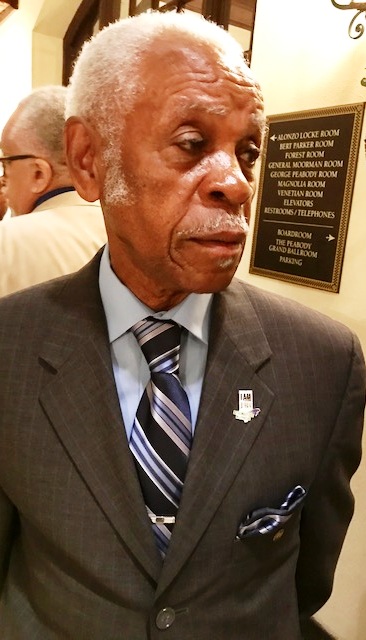
Elmore Nickelberry: 53 Years on a Memphis Garbage Truck

By: Harold Michael Harvey

Elmore Nickelberry
In 1964 Elmore Nickelberry was 32 years old. He was the father of five children.  He was a hero of sorts, but no one knew it or if they did know it, they gave him no recognition for his sacrifice and service to his country.

That year, Nickelberry was discharged from the United States Army, where he had served in the early stages of America's involvement in the Vietnam War. His release was bitter sweet.

On the one hand he was released from his tour of duty as President Lyndon Johnson was preparing to escalate America's involvement in Southeast Asia. But in 1964 he was unemployed and had to find a way to support his family back home in Memphis, Tennessee without the benefit of his Army wages.

It was hard for a Black man to find work, meaningful or otherwise in Memphis in the 1960s. Nickelberry found two menial part time jobs which required him to work during the night hours. He was constantly seeking a daytime job to replace the two part time jobs he had.

Each morning after completing his shift on the second part time job, Nickelberry would look for a full time job with day hours. The Memphis Sanitation Department had full time jobs that he could work during the day. The work conditions were very filthy; it was hard labor and demeaning to the honor and dignity of a military hero.

Nevertheless, Nickelberry sought a job with the Memphis Sanitation Department as a garbage man. At the very least the job would allow him to be at home with his family at night so that he could offer his family the protection that he had rendered to Vietnamese families during his tour of duty.

The problem with this idea was that Memphis had about as many Negroes as it wanted to pay on its sanitation trucks and they were not in any hurry to hire anymore Negroes to pick up garbage in the city. The department was content with working the ones they had very hard.

For a period of  two weeks Nickelberry would leave his second job every day and go to stand in a line with other Negro men in front of the sanitation department office seeking a chance to apply for a job to pick up garbage on the side of streets made famous by W. C. Handy, Elvis and B. B. King.

With Bernard Lafayette
"It would get hot out there," Nickelberry said recently at the Peabody Hotel where he was the guest of the Southern Christian Leadership Conference during their 59th National Convention.

"It was hot out there. I was tired and I got hungry, but I stood in that line. I was used to standing in formation from the Army, so it was not a big problem for me to do. Then one day a white fellow came out of the office," he said.

"Boy, you been standing out here for two weeks, aint you," the white fellow queried?"

"Yes sir, I sure have," Nickelberry said to the sanitation employee.

"Come over here, I think I can find a job for you," the staffer said.

The next day, Nickelberry was on the back of a garbage truck, jumping off to pick up garbage cans and dump them into the truck and jumping back on the truck for the next stop.

The job was as bad as it looks from the to any reasonable observer: sweaty, stinky, low paying, unsanitary; and supervised by a mean spirited white boss.

By the time that Nickleberry had spent four years on the job, Black sanitation workers had become increasingly vocal in expressing concerns about theire working conditions. It was now 1968, and the only job a Black man could get in the Sanitation Department was on the back of the truck. There were no white garbage men working with Black crews. However, all of the garbage truck drivers were white.

On February 1, 1968 two sanitation workers were accidentally killed on a sanitation truck. Their deaths led sanitation workers to organize for better working conditions.

First and foremost these workers wanted to be treated like the grown men that they were; as evidenced by the protest posters they carried during the Memphis Sanitation Workers Strike: "I Am A Man,"  one placard proudly pronounced.

Nickelberry joined the picket line and endured the wrath of Mayor Henry Loeb, III, an avowed segregationist, and the sanitation department managers. When Loeb refused to negotiate with the sanitation strikers they struck, bringing a halt to garbage collection in the city.

The strike was supported by both Roy Wilkins, President of the National Association of Colored People and Dr. Martin Luther King, Jr.

King had never become involved in a labor dispute, and many of his confidants advised him against getting involved with the sanitation strike. We know the rest of this story. King did travel to Memphis. He got in the middle of this labor war. He was gunned down outside of room 306 of the Lorraine Motel on April 4, 1968.

Twelve days after King was murdered, Loeb met with the sanitation workers and conceded to their core demands for better working conditions, recognition of the union and a pay raise.

Following the strike, Nickelberry went back to work on the back of the sanitation truck. Today Nickelberry is 85 years old, and every work day since the strike ended in '68, he has been on a Memphis Sanitation truck. The only difference is he now works as a driver.

"Dr. King gave his life for that strike, did he die in vain," he was asked?

"Many things have changed, but there are a lot more things that need to change," he said after a reflective moment.

"How much longer are you going to work," a reporter asked Nickelberry during the SCLC conference.

"Oh, I don't know. I may retire next year. It'll be 50 years since the strike," he said.

"You have worked this long, what are you going to do in retirement," he was asked.

"I'll probably buy me a wide brimmed hat, a pair of brogan shoes and travel out to California and do some fishing in the Pacific Ocean," he said.

Harold Michael Harvey is an American novelist and essayist. He is a Contributor at The Hill, SCLC National Magazine, Southern Changes Magazine and Black College Nines. He can be contacted at hmharvey@haroldmichaelharvey.com